Sleep Cocoa: What It Is and Why It Works
Hot chocolate that works the night shift: what sleep cocoa is, what the research says about its ingredients, and how to choose one worth drinking.

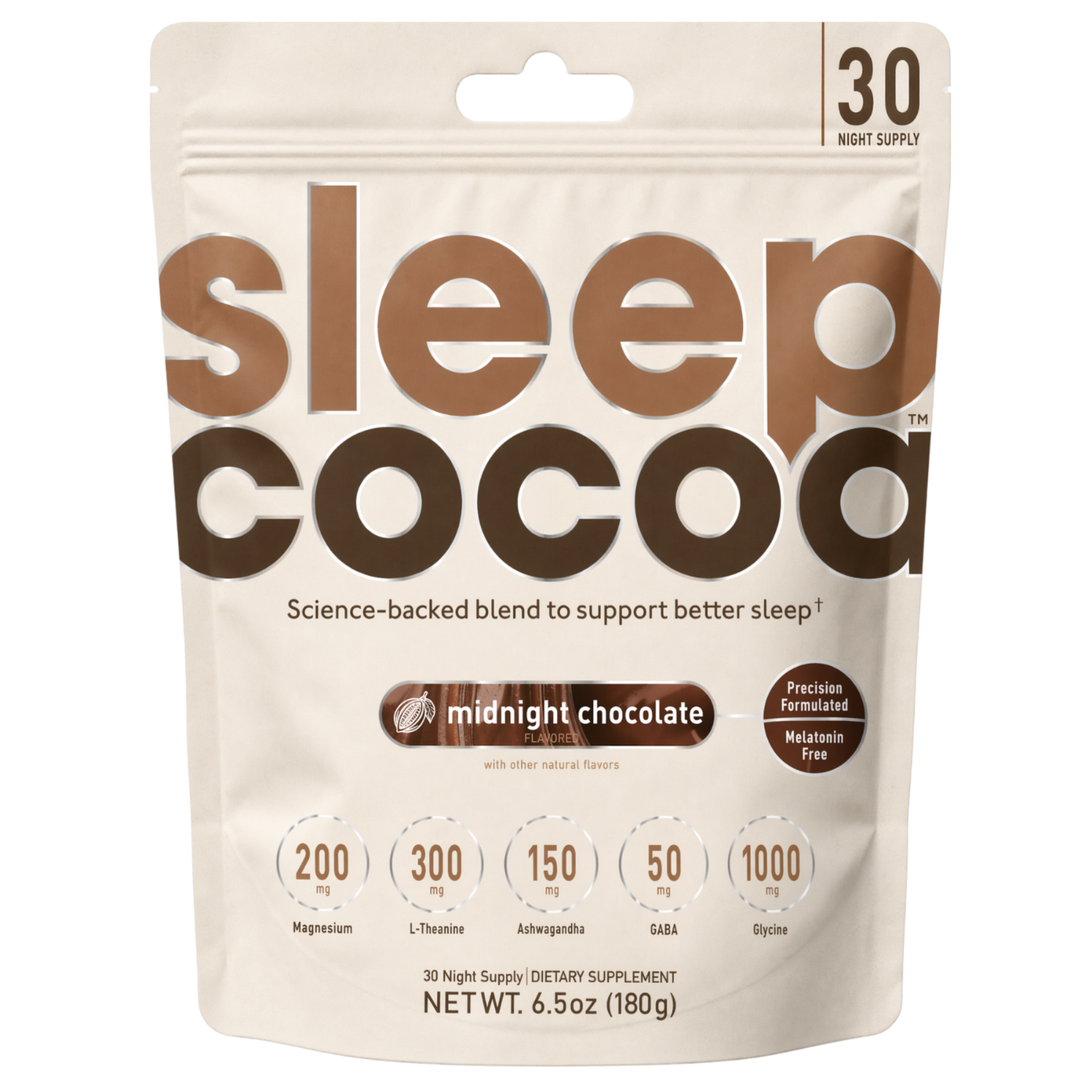
A mug of SleepCocoa's Midnight Chocolate, the centerpiece of a melatonin-free wind-down.
Sleep cocoa is a warm chocolate drink formulated with sleep-supporting ingredients such as magnesium, glycine, and calming herbs, designed to help your body wind down at night without melatonin.* It looks like hot chocolate. It works like a ritual. And for a growing number of people who are tired of waking up groggy from melatonin pills, it has become the last thing they taste before bed.
What is sleep cocoa, exactly?
Strip away the branding and sleep cocoa is a simple idea: take the drink people already reach for when they want to feel cozy, and rebuild it around ingredients that have been studied for relaxation and sleep quality.*
The idea has a longer lineage than the category name suggests. Warm milk before bed goes back generations. Malted bedtime drinks had their era in the last century, marketed on comfort more than chemistry. What changed recently is that the ingredients people were taking as capsules, magnesium, glycine, theanine, adaptogens, started migrating into the evening drink itself. Somewhere along the way, formulators noticed the obvious: nobody skips hot chocolate the way they skip pills.
A typical mug of sleep cocoa starts with real cocoa, then layers in some combination of minerals like magnesium and zinc, amino acids like glycine and L-theanine, and botanicals like chamomile, valerian, and tart cherry. The sugar is usually replaced with a low-glycemic sweetener such as monk fruit, because a blood sugar spike at 10pm works against the whole point.
The category sits between two older options. On one side, plain hot chocolate: comforting, but sugary and doing nothing specific for sleep. On the other, sleep supplements in pill form: functional, but clinical and easy to forget. Sleep cocoa borrows the comfort from one and the function from the other, and asks a fair question of both: why were these ever separate things?
Sleep cocoa vs regular hot chocolate vs a melatonin pill
The easiest way to understand the category is to compare it with what it replaces.
| What matters | Regular hot chocolate | Melatonin pill | Sleep cocoa |
|---|---|---|---|
| Sleep-supporting ingredients | None by design | One hormone | Minerals, amino acids, herbs |
| Sugar per serving | Often 20g or more | None | Low, monk fruit sweetened |
| Next-morning grogginess reports | No | Common complaint | Designed to avoid it |
| Fits a wind-down ritual | Yes | Not really | Yes, built for it |
| Feels like a treat | Yes | No | Yes |
General category comparison. Individual products vary; check the label of any product you consider.
The middle column deserves a fair note. Melatonin has legitimate, researched uses, particularly for jet lag and shift work. The case for sleep cocoa is not that melatonin is useless. It is that a nightly hormone dose is the wrong default for an everyday routine, which we cover in depth in our complete guide to melatonin-free sleep aids.
The comparison also explains who ends up in this category. Almost nobody arrives at sleep cocoa first. They arrive from one of the other two columns: hot chocolate drinkers who want their nightly mug to do more, or melatonin users who want their mornings back. Sleep cocoa is the meeting point.
What goes into a well-formulated sleep cocoa
Not all sleep cocoas are built alike, but the strongest formulas draw from the same well-studied toolkit.
Minerals
Magnesium is the anchor ingredient in most serious formulas. The form matters as much as the amount: magnesium glycinate, the mineral bound to the amino acid glycine, is the evening favorite because it is gentle on the stomach in a way cheaper forms like magnesium oxide are not. Watch for the elemental number on any label. A product can advertise 1,000mg of magnesium glycinate, but the actual magnesium inside that compound, the elemental amount, is what your body receives. In SleepCocoa's case, 1,000mg of magnesium glycinate delivers 200mg of elemental magnesium.
Zinc rides along in smaller amounts, 5mg of zinc bisglycinate per serving in our formula, as a cofactor involved in normal sleep-wake regulation.* It is a supporting actor, not a headliner, and honest formulas treat it that way.
Amino acids
Glycine, L-theanine, and L-tryptophan show up again and again, and each earns its slot differently. Glycine has been studied for subjective sleep quality at 3g doses, and it doubles as a calming neurotransmitter in its own right; SleepCocoa includes 1,000mg per serving alongside the additional glycine bound into the magnesium.* L-theanine, the calm-without-drowsiness compound from tea leaves, appears at 300mg, on the higher end of what formulas typically carry.* L-tryptophan, dosed at 200mg, is the raw material your body walks through its own assembly line: tryptophan to serotonin to melatonin, made in-house, on your body's own schedule.*
GABA rounds out the group at 50mg. It is the nervous system's primary inhibitory neurotransmitter, the biochemical equivalent of a dimmer switch, and it appears in evening formulas as a modest supporting dose.*
Botanicals and adaptogens
The herbal layer is where tradition and modern research overlap. Chamomile and valerian are the two most familiar names, carried over from centuries of bedtime teas. Tart cherry is the modern entrant, studied for its relationship to the body's own melatonin production. Holy basil arrives from Ayurvedic practice as a calming adaptogen. Saffron, the most expensive spice in the world, has become an unexpected subject of clinical mood research. And ashwagandha brings some of the strongest trial data in the adaptogen category, particularly on stress markers.*
SleepCocoa blends these five botanicals with ashwagandha at 150mg and a 1,353mg calming herbal blend of chamomile, valerian, tart cherry, holy basil, and saffron. The design principle is the point: no single hero ingredient, but a system of complementary mechanisms working the same shift.* The best formulas in this category, ours or anyone's, use meaningful combined doses rather than sprinkling one herb in for the label.
Magnesium Glycinate
1,000mg → 200mg elementalThe workhorse mineral of the sleep cocoa category, bound to glycine for gentle absorption.
What the research shows
Sleep cocoa as a finished product is a young category, so the honest way to read the science is ingredient by ingredient. Here is what peer-reviewed research has found about the core components.
In a double-blind, placebo-controlled trial, 500mg of daily magnesium was associated with improvements in sleep time, sleep efficiency, and how quickly participants fell asleep.*
Abbasi B, et al. J Res Med Sci. 2012 ↗A review of human studies reported that 3g of glycine before bed was associated with improved subjective sleep quality and reduced daytime sleepiness, possibly through a small drop in core body temperature.*
Bannai M, Kawai N. J Pharmacol Sci. 2012 ↗A review of randomized trials found that L-theanine, an amino acid found in tea, was associated with reduced stress and anxiety measures in people exposed to stressful conditions, without causing drowsiness.*
Williams JL, et al. Plant Foods Hum Nutr. 2020 ↗In a 60-day randomized, double-blind, placebo-controlled study, adults taking ashwagandha root extract showed significant reductions in perceived stress scores and serum cortisol compared with placebo.*
Chandrasekhar K, et al. Indian J Psychol Med. 2012 ↗The herbal side of the formula leans on a similar body of single-ingredient work, including published trials on tart cherry and sleep measures and on saffron and mood. We unpack those studies in our ingredient deep dives on the Sleep Science Library.
Two caveats worth stating plainly. Most of these studies used single ingredients, not finished cocoa blends, and doses vary between studies and products. A trial that used 500mg of magnesium tells you something real about magnesium, but it does not automatically transfer to any product listing magnesium on the label, especially when the label hides the dose. That is why ingredient transparency matters more in this category than in almost any other: it is the only way to compare what you are buying against what was actually studied.
Why the best sleep cocoa is melatonin-free
Melatonin is a hormone your body already makes. Taking it nightly as a supplement means adding an outside signal on top of your own, and grogginess the next morning along with unusually vivid dreams are among the most commonly reported complaints, a topic we cover with sources in our melatonin-free guide.
A melatonin-free formula takes a different path: give the body cofactors and calming compounds, then let your own melatonin do its job on its own schedule.* No hormone, no morning fog to push through, no wondering whether you can skip a night.
The distinction shows up in how the two approaches age. A hormone dose does the same blunt thing on night one and night three hundred. A cofactor approach is built for repetition: the ingredients supply what the nightly process uses, and the ritual around them compounds. That is why melatonin-free is not a lesser version of the melatonin gummy. It is a different philosophy about whose job sleep is, yours or the supplement's.
Melatonin tells your body it is nighttime. Melatonin-free ingredients help your body act on the nighttime signal it already has.*
How to work sleep cocoa into your night
The formula matters, but the routine is where the results live. A concrete example: if you want lights out at 10:30pm, start heating water or milk at 9:45pm. Whisk in the cocoa, then take the mug somewhere screens are not. Dim lights, warm drink, ten unhurried minutes.
Two practical notes. First, warm liquid raises skin temperature slightly, and the gentle cool-down afterward mirrors what your body does naturally as it approaches sleep. Second, drinking the same thing at the same time every night builds a cue. After a few weeks, the smell of chocolate at 9:45pm starts to mean something to your nervous system.
Set expectations honestly, too. This is not a knockout drop, and the first night is not the test. Ingredient-based approaches tend to build with consistent use, which is why the fair evaluation window is measured in weeks. A reasonable arc looks like this: week one, the ritual itself starts settling your evenings; weeks two and three, the routine compounds and your body starts anticipating the wind-down; by week four you have real data about how you fall asleep and how you feel at 7am. Judge it there, not on night two.
Consistency beats perfection here. A sleep cocoa used nightly for a month tells you far more than one used twice. That evaluation math is also why a short return window is a red flag in this category, and why we made ours 60 nights.
Who sleep cocoa is for, and who it is not
Sleep cocoa fits people whose sleep problem starts before bed: the wired-and-tired crowd, the ones who scroll because they cannot settle, the melatonin users who hate the next morning. It also fits anyone who simply wants their evening to have a floor under it, a fixed point the rest of the night organizes around.
A few familiar profiles. The parent whose only quiet hour starts at 9pm and who spends it too keyed up to use it. The knowledge worker whose laptop closes at 9:30 and whose mind does not. The former melatonin regular who can fall asleep fine but resents what mornings have become. The common thread is not broken sleep so much as a missing off-ramp between the day and the bed.
It is not for everyone, and pretending otherwise would be bad science and worse manners. If you have a diagnosed sleep disorder, work with a clinician; no cocoa replaces medical care. If caffeine keeps you up, note that cocoa naturally carries a small amount of caffeine and theobromine, far less than coffee, but sensitive sleepers should time it earlier in the evening. If your sleep problem is downstream of something else entirely, pain, apnea, medication timing, a newborn, address the cause first. And if you are pregnant, nursing, or taking medication, check with your doctor before adding any supplement, cocoa-based or not.
How to choose a sleep cocoa
The category is growing fast, and quality varies more than the packaging suggests. Some products are genuine formulations with disclosed doses; others are hot chocolate with a pinch of something calming and a moon on the label. A quick word on value, too: judge cost per night, not price per bag. A 30-serving pouch works out to a dollar or two a night, which is worth weighing against what a single cafe latte costs, or against the compound cost of another groggy morning.
Use this checklist before you buy anything, ours included.
- ✓Melatonin-free: the formula should work with your body's own signals, not add a nightly hormone dose.
- ✓Full dose disclosure: every ingredient amount listed, no proprietary blends hiding the numbers. Compare them against the studies above.
- ✓Meaningful magnesium: look for the elemental amount, not just the compound weight. SleepCocoa's 1,000mg of magnesium glycinate delivers 200mg elemental.
- ✓Third-party tested: an independent lab should verify what is in the bag. SleepCocoa is tested by Eurofins.
- ✓Low sugar: monk fruit or similar, because a sugar spike at bedtime undercuts the goal.
- ✓A guarantee long enough to matter: sleep routines take weeks to judge. A 60-night window respects that; a 14-day one does not.
The bigger picture: ritual beats willpower
Most sleep advice fails not because it is wrong but because it asks for discipline at the exact hour of the day when discipline is gone. Nobody wants to journal, stretch, and meditate at 10pm. A warm mug of chocolate, though, is not a chore. It is the rare healthy habit that feels like the reward.
This is the quiet insight the whole category rests on. Adherence, the unglamorous science of whether people actually keep doing the thing, decides the outcome of every wellness routine ever designed. The best formula on earth does nothing in a drawer. Build the active ingredients into a moment people already want, and the adherence problem mostly solves itself.
The best sleep aid is the one you actually look forward to at 9:45 on a Tuesday night.
— SleepCocoa Research TeamThat is the real answer to why sleep cocoa works: it stacks studied ingredients on top of a ritual you will actually keep.* If you want to see how we built ours, the full formula and every dose is on our ingredients page, and the drink itself is here. Curious how the category compares with the classic mug? We broke that down in does hot chocolate help you sleep.
- 1Sleep cocoa is a warm chocolate drink rebuilt around studied ingredients like magnesium, glycine, and calming herbs, with no melatonin.* The strongest formulas disclose every dose; magnesium glycinate, glycine, L-theanine, and ashwagandha carry the most research weight. Peer-reviewed trials link these individual ingredients to better sleep quality and lower stress markers, though studies used single ingredients, not finished blends.* Melatonin-free matters because a nightly hormone dose can mean grogginess and vivid dreams; cofactor ingredients work with your body's own signals.* The ritual is half the mechanism: same mug, same time, every night builds a cue your nervous system learns to follow. Judge any sleep cocoa on dose transparency, third-party testing, low sugar, and a guarantee long enough to actually evaluate it.
References
- Abbasi B, Kimiagar M, Sadeghniiat K, et al. The effect of magnesium supplementation on primary insomnia in elderly: A double-blind placebo-controlled clinical trial. J Res Med Sci. 2012;17(12):1161-1169. PubMed ↗
*These statements have not been evaluated by the Food and Drug Administration. This product is not intended to diagnose, treat, cure, or prevent any disease. Studies referenced examine individual ingredients, not the finished SleepCocoa product.