Melatonin-Free Sleep Aids: The Complete Guide
Grogginess, vivid dreams, and a nightly habit that was designed for jet lag. Here is the researched case for sleeping without melatonin, and what to use instead.

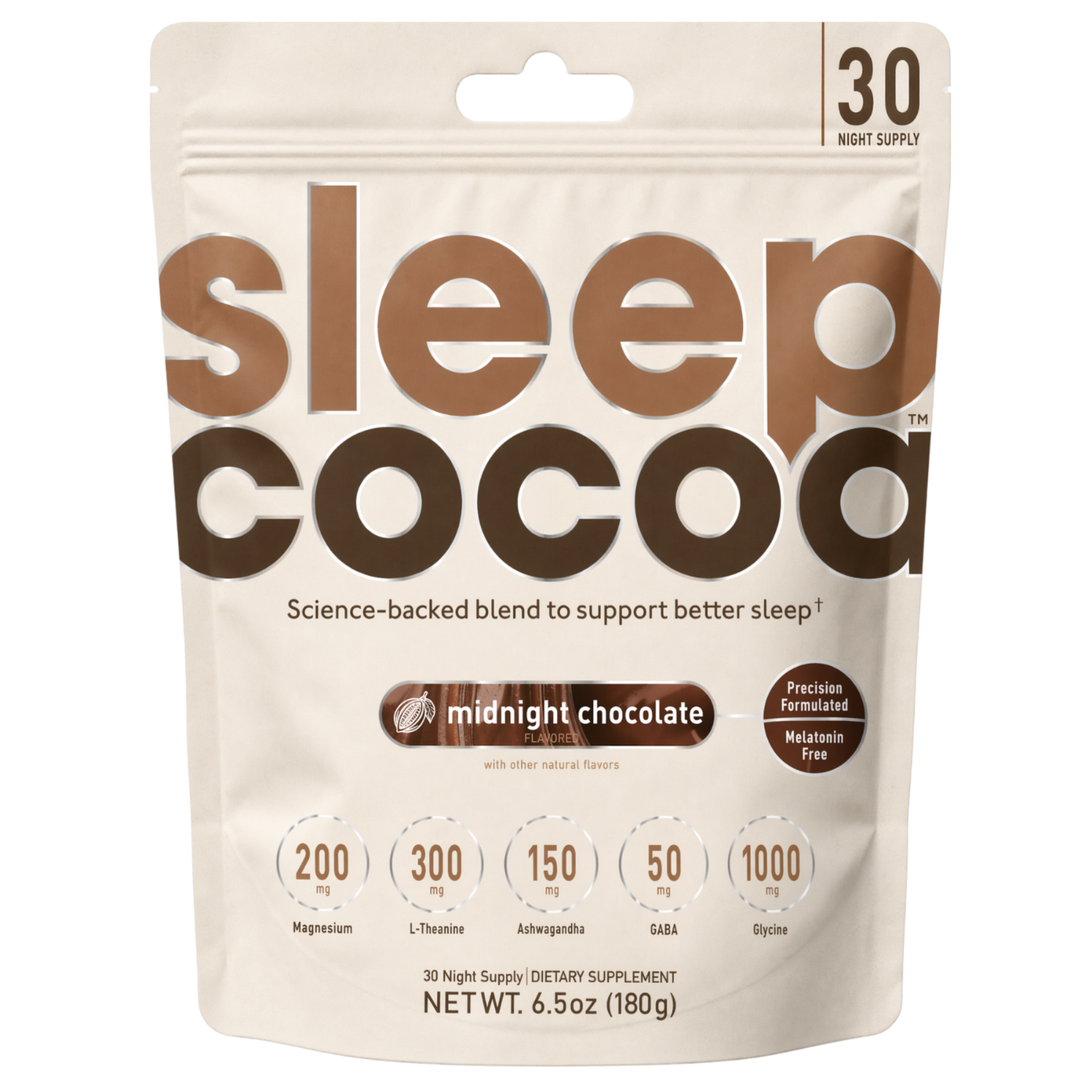
An evening wind-down built on minerals, amino acids, and herbs, the melatonin-free stack inside every mug of SleepCocoa.
Melatonin-free sleep aids use minerals, amino acids, and calming botanicals to support your body's own wind-down process instead of adding an outside dose of a hormone.* If you have ever taken melatonin and dragged yourself through the next morning in a fog, or woken at 3am from a dream that felt like a film you never agreed to watch, this guide is for you. Here is what melatonin actually does, why so many people are moving away from it, and what the researched alternatives look like.
Why melatonin-free is having a moment
Melatonin became the default sleep aid almost by accident. It is cheap, it is sold next to the vitamins, and it is marketed as natural. For occasional, specific uses, that reputation is partly earned. The National Institutes of Health notes that melatonin appears most useful for circadian problems like jet lag, where the goal is shifting your body clock.1
The trouble started when a jet lag tool became a nightly habit. Use has climbed steeply over the past decade, with many adults taking it every single night at doses far above what the body produces on its own. The complaints climbed with it: morning grogginess, strange dreams, and a creeping sense of needing it to sleep at all. That gap, between what melatonin is for and how it is actually used, is what the melatonin-free category exists to fill.
It helps to name what is actually being sold. Melatonin owes its shelf position to a regulatory accident: in the United States it is classified as a dietary supplement, so it sits next to vitamin C, while much of Europe treats it as a medicine available by prescription. Same molecule, very different level of caution. When two regulatory systems look at one compound and reach opposite conclusions, the honest takeaway for a nightly user is not that one of them is silly. It is that the question deserves more thought than the gummy aisle implies.
What melatonin actually is
Melatonin is not a sedative. It is a timing signal. Your brain's pineal gland releases it as light fades, telling every system in your body that night has arrived. It does not knock you out the way a sleeping pill does; it opens a biological gate that sleep can walk through.
That distinction explains both its uses and its limits. If your body clock is genuinely misaligned, crossing time zones, working a night shift, a well-timed dose can help reset the schedule.1 But if your clock is fine and your problem is a racing mind at 10pm, extra melatonin is answering a question your body did not ask.
Notice also what your body does with its own melatonin: it releases a tiny amount, on a precise curve, then clears it before morning. The typical store-bought dose arrives all at once, at whatever hour you took it, and at many times the physiological level. Even before any research on side effects, the mismatch between how the hormone is designed to behave and how the supplement behaves should give a nightly user pause.
Melatonin tells your body it is nighttime. It does not help a stressed, wired body act on that signal. Most modern sleep problems live in the second category, not the first.
The side effects people actually notice
Three complaints come up constantly with regular melatonin use.
Next-morning grogginess
Drowsiness and a hungover feeling the next day are among the commonly reported side effects of supplemental melatonin, along with headache, dizziness, and nausea.2 One likely culprit is dose and timing: supplemental doses can hold blood melatonin elevated well past the hour your own production would have tapered off.
Vivid dreams
Unusually intense or strange dreams are a frequently reported experience with melatonin supplementation.3 For some people this is a curiosity. For others it means fragmented, restless nights that defeat the purpose.
The psychological crutch
Perhaps the most underrated issue: many nightly users describe feeling unable to sleep without it. Whether or not the body builds a true physiological tolerance, the belief alone can turn a supplement into a dependency of habit. Sleep is unusually suggestible territory. Convince yourself you cannot sleep without a gummy and you have manufactured a real problem out of an unnecessary one, which is a poor trade for a supplement that was meant to be occasional.
Is nightly melatonin actually safe?
The honest answer from the research community: short-term use appears safe for most adults, and the long-term picture is simply understudied.1 That is not an alarm bell, but it is a reason for humility, especially when the supplement in question is a hormone.
Two practical concerns sharpen the point. First, dosing in consumer products commonly runs from 1mg to 10mg, several times anything physiological. Second, independent testing of melatonin products has repeatedly found that actual content can differ substantially from the label. With a hormone, that variability matters.
None of this makes melatonin a villain. It makes it a specialist tool being used as an everyday one. If you use it for jet lag a few nights a year, the research is on your side. If it has become a nightly ritual, there are alternatives built for exactly that job.
The melatonin-free toolkit: minerals and amino acids
Melatonin-free formulas work from a different premise: supply the nutrients and calming compounds your nervous system uses to wind itself down, then get out of the way.* No single ingredient here is a knockout switch, and that is by design. Wind-down is a multi-system event, part mineral status, part neurotransmitter chemistry, part temperature, part stress load, so serious formulas stack several modest, studied mechanisms rather than betting the night on one.
Magnesium
The most studied mineral in the sleep conversation. Magnesium participates in hundreds of enzymatic reactions, including several involved in nervous system regulation, and supplementation has been studied for sleep quality in controlled trials.* Form matters: the glycinate form is the evening standard because it is bound to the calming amino acid glycine and is gentle on digestion, where cheaper oxide forms are poorly absorbed and famous for other effects. Read labels for the elemental amount, the magnesium actually inside the compound. SleepCocoa uses 1,000mg of magnesium glycinate delivering 200mg elemental per serving.
Glycine
An amino acid that doubles as a calming neurotransmitter. Clinical work has linked pre-bed glycine to improved subjective sleep quality, possibly through a small drop in core body temperature, which is one of the body's natural sleep cues.* It is also one of the cheapest, most gentle ingredients in the entire toolkit, with a mildly sweet taste that makes it easy to fold into an evening drink. SleepCocoa carries 1,000mg per serving, plus the glycine bound into the magnesium glycinate itself.
L-theanine
Found naturally in tea, L-theanine has been studied for promoting relaxation without sedation.* It is the reason a cup of tea can feel simultaneously alert and calm. That no-drowsiness profile makes it a staple of formulas designed to leave mornings clean, and it pairs naturally with the racing-mind problem: the people who lie down tired and light up mentally the moment the room goes dark. SleepCocoa doses it at 300mg.
L-tryptophan and GABA
L-tryptophan is the dietary building block your body converts, step by step, into its own serotonin and melatonin. This is the elegant part of the melatonin-free logic: rather than importing the finished hormone, you supply the precursor and let your body run its own production line, on its own schedule, with its own quality control.* SleepCocoa includes 200mg. GABA, the nervous system's primary calming neurotransmitter, appears alongside it at a modest 50mg supporting dose.
Zinc
A quiet cofactor in normal sleep-wake regulation, typically dosed small.* SleepCocoa uses 5mg of zinc bisglycinate, 45% of the daily value, enough to matter as a cofactor without crowding the formula.
The melatonin-free toolkit: botanicals and adaptogens
Herbs carry centuries of traditional use and a growing, if uneven, body of modern research. The ones that appear most often in serious formulas each bring a distinct angle.
Chamomile and valerian are the classic calming pair, carried from the tea aisle into modern formulations. Their traditional track record is measured in centuries, and they remain the most recognizable names in the category. Tart cherry is the modern entrant, notable because it has been studied in connection with the body's own melatonin production, supporting the natural pathway from the outside rather than replacing it.* Holy basil, or tulsi, arrives from Ayurvedic tradition as a calming adaptogen for the stress side of the sleep equation. Saffron has quietly become a subject of published mood research, an unusual second career for the world's most expensive spice. And ashwagandha carries some of the strongest trial data in the adaptogen world, particularly for stress markers like cortisol, which is why it anchors the adaptogen slot in many evening formulas, including ours at 150mg.*
Quality varies enormously between products here, more than in any other part of the toolkit. Herbs are where proprietary blends go to hide underdosing. Two questions cut through the noise: is the dose disclosed, and does it resemble anything actually studied? A transparent ingredient panel answers both in thirty seconds. SleepCocoa's calming herbal blend runs 1,353mg across chamomile, valerian, tart cherry, holy basil, and saffron, with the full breakdown published.
What the research shows
Three findings anchor the melatonin-free approach.
In a double-blind, placebo-controlled trial, 500mg of daily magnesium was associated with improved sleep time, sleep efficiency, and faster sleep onset, alongside favorable shifts in the body's own sleep-related hormones.*
Abbasi B, et al. J Res Med Sci. 2012 ↗A review of human studies reported that 3g of glycine before bed was associated with improved subjective sleep quality and less daytime sleepiness, without the hangover profile of sedatives.*
Bannai M, Kawai N. J Pharmacol Sci. 2012 ↗In a placebo-controlled crossover study, tart cherry juice concentrate was associated with increased urinary melatonin, longer total sleep time, and improved sleep efficiency in healthy adults, evidence for supporting the body's own melatonin pathway from the outside.*
Howatson G, et al. Eur J Nutr. 2012 ↗The fair caveat: these trials studied single ingredients at specific doses, not finished blends, and no supplement research entitles any product to promise results. Trial populations differ from you, effect sizes are usually modest, and consistency of use matters more than any single night. What the evidence supports is a reasonable, hormone-free starting point for people who want their nightly routine built on cofactors rather than a nightly hormone dose.*
Building a melatonin-free night that works
Supplements are one layer. They work best inside a routine that points the same direction. A realistic version, anchored to a 10:30pm lights-out:
- ✓9:00pm, lights down: dim the bright overheads. Fading light is the signal your own melatonin responds to; do not fight it with a kitchen lit like an operating room.
- ✓9:45pm, the ritual anchor: a warm, melatonin-free drink at the same time nightly. Repetition turns it into a cue your nervous system recognizes. This is the slot where sleep cocoa lives.
- ✓10:00pm, screens down: not for purity, but because feeds are engineered arousal. Trade the last half hour for anything slower: paper, podcast, a person.
- ✓10:30pm, same time nightly: a consistent sleep window does more for your body clock than any supplement, melatonin included.
- ✓Give it three weeks: nutrient-based approaches build; they do not knock you out on night one. Judge the routine on week three, not day two.
If you are coming off nightly melatonin
A practical note for the many readers arriving here mid-habit. Melatonin is not a medication that requires a taper, but switching cold from a nightly dose to nothing can feel abrupt, partly for reasons of expectation rather than biology. A gentler path: start the melatonin-free routine above while you are still using melatonin, run both for a week so the new cues are established, then drop the melatonin and keep the routine. Expect a few unremarkable nights of adjustment and resist the urge to declare a verdict from them. If you have been using high doses for a long time, or you take other medications, loop in your doctor before changing anything.
How to choose a melatonin-free sleep aid
Whether you choose a drink, a capsule, or a powder, the same filters apply. Demand a full ingredient panel with every dose disclosed, then compare those doses against the studies above. Look for third-party testing from an independent lab, since trust in this category has to be earned in writing. Prefer formulas that combine several complementary ingredients over one-ingredient wonders, because wind-down is a multi-system event. And favor companies that give you long enough to actually evaluate the product; nightly routines reveal themselves over weeks, which is why SleepCocoa carries a 60-night guarantee.
The red flags are just as consistent. A proprietary blend with no doses is a dose you would not be shown. The phrase melatonin-free on the front of a label with melatonin's cousins quietly absent from the back panel entirely, no minerals, no amino acids, just flavoring and a herb dusting, means the product is marketing a category without carrying its substance. And any sleep product promising instant results has already told you it does not understand, or does not respect, how this approach works.
Format is the underrated variable. A capsule is easy to forget and easy to quit. A warm drink you look forward to is a routine that keeps itself. Adherence decides outcomes in every corner of wellness, and adherence is a design problem, not a willpower problem. That logic, a full melatonin-free stack folded into a mug of real chocolate that you actually anticipate at 9:45pm, is the entire design brief behind SleepCocoa.
Melatonin answers a question most sleepers are not asking. The better question is what your body needs to wind itself down.
— SleepCocoa Research TeamStill weighing the tradeoffs? Our breakdown of whether hot chocolate helps you sleep covers the gentler end of the spectrum, and our FAQ answers the practical questions about nightly use.
- 1Melatonin is a timing hormone, not a sedative; research supports it mainly for circadian problems like jet lag, not nightly use for a racing mind. Commonly reported downsides of supplemental melatonin include next-morning grogginess, vivid dreams, and headache, and long-term nightly use is understudied. Melatonin-free alternatives work by supplying cofactors: magnesium, glycine, L-theanine, L-tryptophan, GABA, and calming botanicals.* Controlled trials link magnesium to improved sleep efficiency and glycine to better subjective sleep quality.* Routine multiplies results: dim lights by 9pm, a consistent warm-drink ritual, screens down, and a fixed lights-out time. Choose products on dose transparency, third-party testing, and a trial window long enough to judge a nightly routine.
References
- National Center for Complementary and Integrative Health. Melatonin: What You Need To Know. National Institutes of Health. PubMed ↗
*These statements have not been evaluated by the Food and Drug Administration. This product is not intended to diagnose, treat, cure, or prevent any disease. Studies referenced examine individual ingredients, not the finished SleepCocoa product.